
Why many antimicrobial surface claims fall short in the real world
When antimicrobial products are evaluated, the focus often stays on bacterial reduction. A coating shows activity in a lab test. A treated fabric claims odor control. A device surface is described as antimicrobial. Those results can sound strong on paper, but they often miss the more important question: what happens when bacteria form a biofilm?
That is where real-world performance becomes harder to prove.
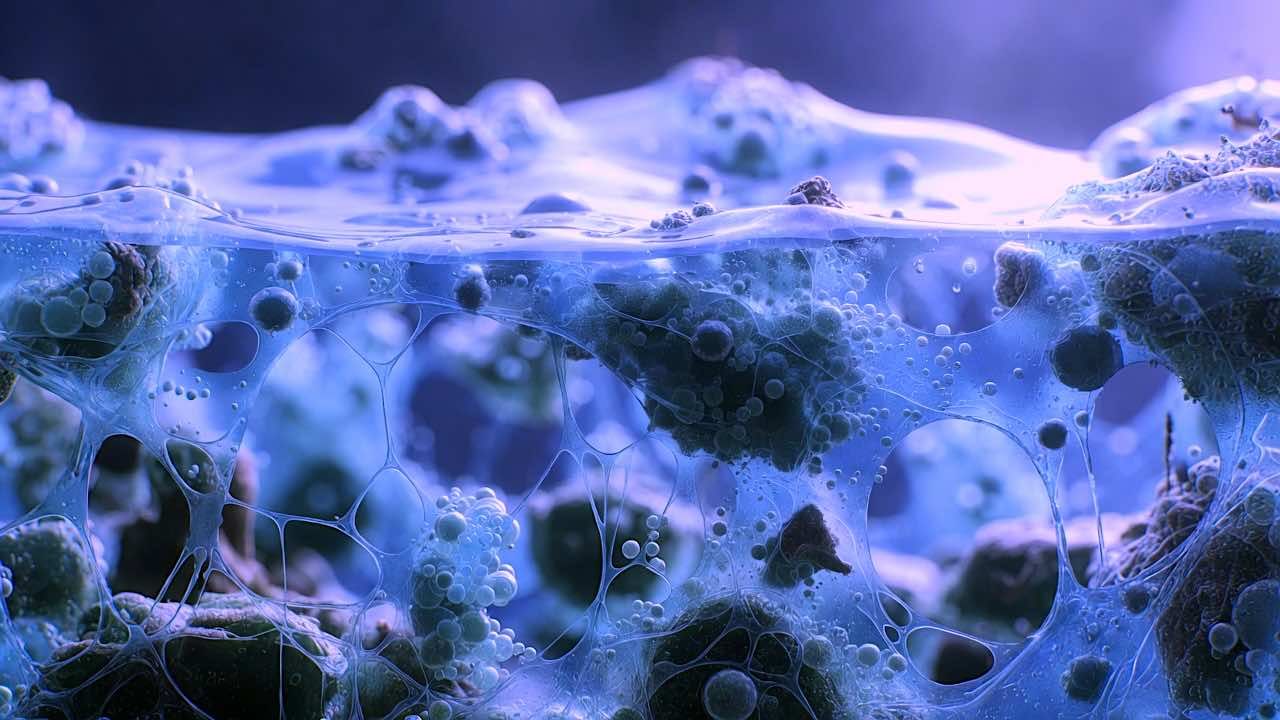
Biofilms are not simply bacteria sitting on a surface. They are structured microbial communities that attach, grow, and generate a protective matrix. Once that matrix forms, bacteria become much harder to remove, disrupt, or control. A material may perform well against planktonic bacteria, the free-floating form commonly used in standard antimicrobial testing, yet still underperform in practical environments where biofilms persist.
That distinction matters across healthcare, textiles, consumer products, and industrial systems. The key question is not only whether a material reduces bacteria under ideal laboratory conditions. The better question is whether it helps reduce bacterial adhesion, slows early colonization, and limits biofilm formation before it becomes established.
That is the real performance challenge.
What a biofilm is, and why it matters
A biofilm forms when microorganisms attach to a surface and begin producing a self-generated extracellular matrix. That matrix anchors microbes in place and helps shield them from cleaning, chemical exposure, and environmental stress.
Once that structure develops, the problem changes. The goal is no longer simple surface reduction. The challenge becomes disrupting an organized microbial community built to persist.
This matters because biofilms form in the environments products actually face in use. In healthcare, they can develop on catheters, connectors, and implants, where persistent microbial attachment can increase contamination concerns and contribute to device-related complications. In textiles, microbial buildup can lead to odor, staining, and gradual material degradation. In water systems and industrial settings, biofilms can drive fouling, reduce efficiency, and increase maintenance demands.
The central issue is persistence. A disinfectant may reduce bacteria on the outer surface without fully disrupting the community beneath. A surface treatment may show early antimicrobial activity, then lose effectiveness under repeated contamination, cleaning, moisture, or friction. Surviving organisms can remain attached, recover, and continue growing.
That is why biofilms matter in antimicrobial design. They reflect how bacteria behave in use, not just how they behave in a simplified test environment.
Why many antimicrobial claims fail to translate to real use
A common weakness in antimicrobial marketing is that many claims rely on short-term testing against planktonic bacteria. Those tests can provide useful information, but they often measure the easiest part of the problem rather than the hardest one.
That creates a gap between laboratory claims and practical performance.
In real environments, bacteria often do not remain free-floating for long. They attach, organize, and begin building protective communities. Once that process starts, control becomes more difficult. A product that performs well in a controlled reduction test may not deliver the same value under repeated microbial exposure over time.
This limitation appears across several antimicrobial approaches. Surface coatings can wear down on products exposed to handling, abrasion, moisture, or routine cleaning. Chemical treatments may reduce bacterial load initially without offering durable protection against ongoing contamination. Traditional silver-based systems can play an antimicrobial role, but in biofilm environments, the protective matrix can make it harder for active agents to reach embedded bacteria effectively. Textile finishes may support early odor-control claims, then lose performance after repeated wash cycles when the antimicrobial function remains only at the surface.
None of that means antimicrobial technologies lack value. It means the design strategy and the testing standard have to match the real problem. A surface-level claim is not enough when the real challenge is long-term microbial attachment and persistence.
Why biofilm prevention starts with material design
If biofilms are the harder problem, prevention has to start earlier.
That shifts the conversation away from short-term kill claims and toward material-level design. Instead of asking only whether a product kills bacteria on contact, developers should ask more useful questions. Does the material help reduce bacterial adhesion? Can it disrupt early-stage colonization? Is the antimicrobial function integrated into the material itself, or added later as a surface treatment? Will performance hold up under real use conditions?
These questions matter anywhere repeated microbial exposure affects safety, cleanliness, durability, or user experience.
In healthcare, they matter because persistent contamination on device surfaces can contribute to serious downstream risk. In textiles, they matter because odor and degradation often result from ongoing microbial buildup rather than a single exposure. In consumer and industrial products, they matter because durability only matters if antimicrobial performance lasts through use.
This is where material design becomes more than a feature. It becomes the foundation of practical antimicrobial performance.
How EVOQ technology addresses the biofilm challenge
At EVOQ, performance isn't formulated. It's engineered.
The EVOQ platform rests on the principle that effective antimicrobial performance should not depend on a fragile top-layer treatment. EVOQ platform technology uses engineered metamaterials designed to be integrated directly into host materials. Physical architecture governs the interaction, meaning performance is defined at the point of material creation.
That approach matters because embedded functionality offers a more durable path to antimicrobial performance than coatings, sprays, or temporary finishes. The goal is to influence how microbes interact with the material from the earliest stages of adhesion and colonization. Supported by imaging and spectroscopy, the platform's multi-target mechanism—consistent with the proposed S3 (Silver–Sulfur Siege) hypothesis—fundamentally challenges a pathogen’s ability to attach, organize, and persist.
For healthcare applications, EVQ-218 is in development to help reduce bacterial adhesion and biofilm-related risk on device surfaces. In products such as catheters and connectors, early-stage prevention matters. Reducing attachment at the start represents a more practical strategy than trying to overcome a mature microbial community later.
The same principle applies beyond healthcare. In textiles and other consumer materials, integrated antimicrobial functionality can offer a durable alternative to finishes that fade with washing, wear, or time. That supports product performance, consistency, and longevity.
Manufacturing practicality matters, too. Technologies that integrate into existing material systems offer a more scalable path than those dependent on repeated reapplication or complex secondary processing. Durability built at formation is not only a performance advantage; it is an adoption advantage.
The future of antimicrobial surfaces depends on biofilm control
As antimicrobial innovation advances, biofilm prevention remains one of the clearest measures of whether a solution is built for real-world performance.
A product may show strong results in a controlled laboratory setting, but that alone does not guarantee lasting value in use. Surfaces in healthcare, textiles, consumer goods, and industrial environments face repeated microbial challenges, not one-time exposures. The most meaningful solutions will address how bacteria attach, persist, and organize over time.
That is why biofilms are the real test.
For developers and manufacturers, the takeaway is straightforward. A stronger antimicrobial strategy does more than reduce bacteria after contamination occurs. It starts with materials designed at their formation to be less hospitable to microbial attachment and more resistant to the persistent challenges biofilms create.
That is where material science, antimicrobial innovation, and practical performance come together.
Explore the EVOQ platform technology and its application pathways to see how integrated material design supports durable antimicrobial performance.