How EVOQ engineers metamaterials at production
Structure is controlled during formation. That is what makes the EVOQ platform different.
The manufacturing breakthrough
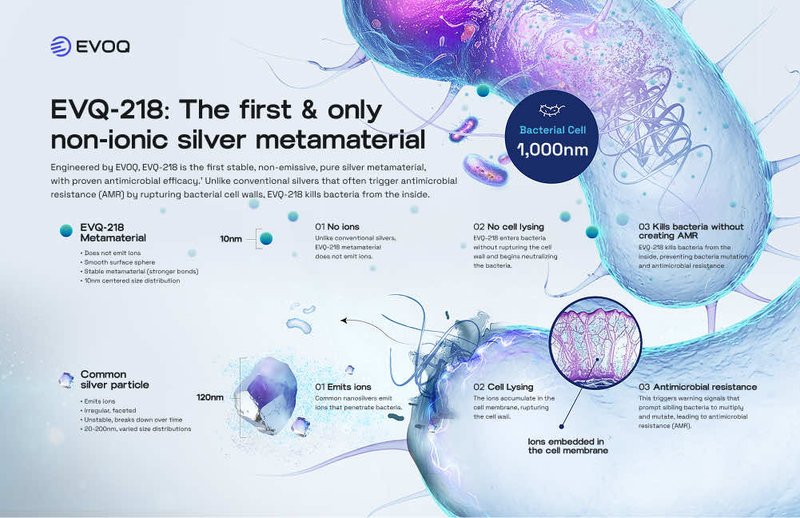
EVOQ uses a patented high-energy laser-ablation platform to form spherical metamaterials directly from source material. By controlling structure during formation, EVOQ avoids the reducing agents, surfactants, capping agents, and post-synthetic correction associated with many wet-chemistry processes. EVQ-218 is the most extensively studied implementation of the platform. Peer-reviewed characterization reports spherical morphology, a very narrow size distribution, and stable, nonemissive surface behavior.
1. Shape
High-energy laser ablation produces EVQ-218 material with a consistently spherical, smooth morphology.
2. Size distribution
Peer-reviewed characterization reports a very narrow size distribution. Exact measurements and analytical methods remain available in the primary technical record.
3. Stability
EVQ-218 characterization reports stable, nonemissive surface behavior without added capping agents.
4. Production
Exceptional batch-to-batch consistency.
Energy replaces chemical synthesis
The EVOQ process uses high-energy laser ablation in water to form material directly from a solid source. There are no chemical reducing agents, surfactants, or added capping agents in the synthesis route.
By establishing structure during formation, the process is designed to produce spherical material with very narrow size distribution and a clean, functional surface.
EVQ-218: the platform in practice
Material structure is set at production, not corrected afterward. That gives research teams a consistent starting point for formulation, coating, polymer, and device-format evaluation.
For EVQ-218, peer-reviewed characterization and third-party testing provide the evidence trail for the material’s physical properties and application-relevant behavior.

Designed for continuous production
EVQ-218 has been evaluated through peer-reviewed serial-passage research across all six ESKAPE pathogens. The study reported no measurable MIC increase after 30 passages.
That result is a defined laboratory finding—not a clinical claim—and it provides a focused basis for continued antimicrobial-material research.

How the process differs from wet-chemistry synthesis
Conventional nanoparticle routes often depend on chemical reducing agents and stabilizing compounds. The EVOQ platform forms material directly through high-energy laser ablation in water, reducing the need to manage residual synthesis chemistry or added surface coatings.
The distinction matters because the production method can influence morphology, surface behavior, and the consistency of the material supplied for downstream work.
Why structure at production matters
The EVOQ platform is designed around controlling the properties that begin at formation: shape, size distribution, surface condition, and batch-to-batch consistency.
This gives collaborators a well-defined material starting point when they are evaluating a formulation, coating, polymer system, device concept, or research protocol.
Resistance-resilience research
EVQ-218’s serial-passage study is part of the platform evidence base. Across all six ESKAPE pathogens, researchers observed no measurable MIC increase after 30 passages. Review the study context and additional test results on the Results page.
Interested in testing EVOQ metamaterials?
Tell us about the target format, substrate, endpoint, and development stage. We’ll identify the most relevant technical records and evaluation pathway.
Connect with an expert